Women's progress in leadership has stalled according to WEF Global Gender Gap Report 2026
The World Economic Forum's Global Gender Gap Report 2026 reveals that achieving global gender parity is still well over a century away.
Marking its 20th edition, the Global Gender Gap Report 2026 covers a cohort of 145 economies and analyses a longitudinal constant sample of 97 economies included in every edition since 2006, providing the longest-running assessment of progress towards gender parity. Considering the collective rate of advancement for the 20-year cohort, global gender parity is estimated to be attained in 120 years.
Currently, there is no economy that has reached full parity. Every economy in the global top 10, however, has closed at least 81% of the gender gap, with European economies making up the majority of best performers.
For the 17th consecutive year, Iceland reports the highest level of gender parity at 93% and remains the only economy to have closed more than 90% of its overall gender gap.
At the current pace, full parity is estimated to be 194 years away for Political Empowerment, 129 years away for Economic Participation and Opportunity, and 8 years away for Educational Attainment.
Progress is possible, but it's not fast enough
Gender parity is fundamental to human development and to unlocking the talent, innovation, creativity and resilience economies will need to navigate the future.
"Across education, economic opportunity, political participation and health, global gender parity has advanced steadily. That progress has been driven by policy reforms and workplace improvements, advocacy and civil society action, shifts in investment and capital allocation, and the daily efforts of countless women and men around the world. Yet twenty years of evidence also tell us something important: progress is possible, but it is neither automatic nor fast enough," says Saadia Zahidi, Managing Director, World Economic Forum.
"One of the clearest lessons of the past twenty years is the value of consistent measurement. Objective data creates visibility, enables comparison, identifies where progress is taking place and helps leaders understand where greater action is needed. But measurement alone does not create change," comments Saadia Zahidi.
Women's advancement in the workplace
According to LinkedIn data, women’s hiring into the overall workforce and senior leadership has stalled since 2022 and shows early signs of decline, suggesting that earlier progress might not be sustained if current trends continue.
Looking at the workplace, there are 3% more women in the top jobs today than there were 10 years ago.
Women enter the workforce in near-equal numbers to men, making up 46% of workers at entry level. During their journey to the top, however, women's representation is halved to 23% in the C-suite. The steepness of this drop to the top reflects structural barriers, not supply. The drop to the top is steepest in industries including transport, construction and technology, where women’s representation more than halves between entry level and the C-suite.
When women do reach the C-suite, they are more likely to work in specific roles, making up 65% of chief people officers, 64% of chief HR officers and 45% of chief marketing officers. In contrast, women are underrepresented in roles with the most operating responsibility, making up 27% of chief financial officers, 24% of chief operating officers and just 19% of CEOs.
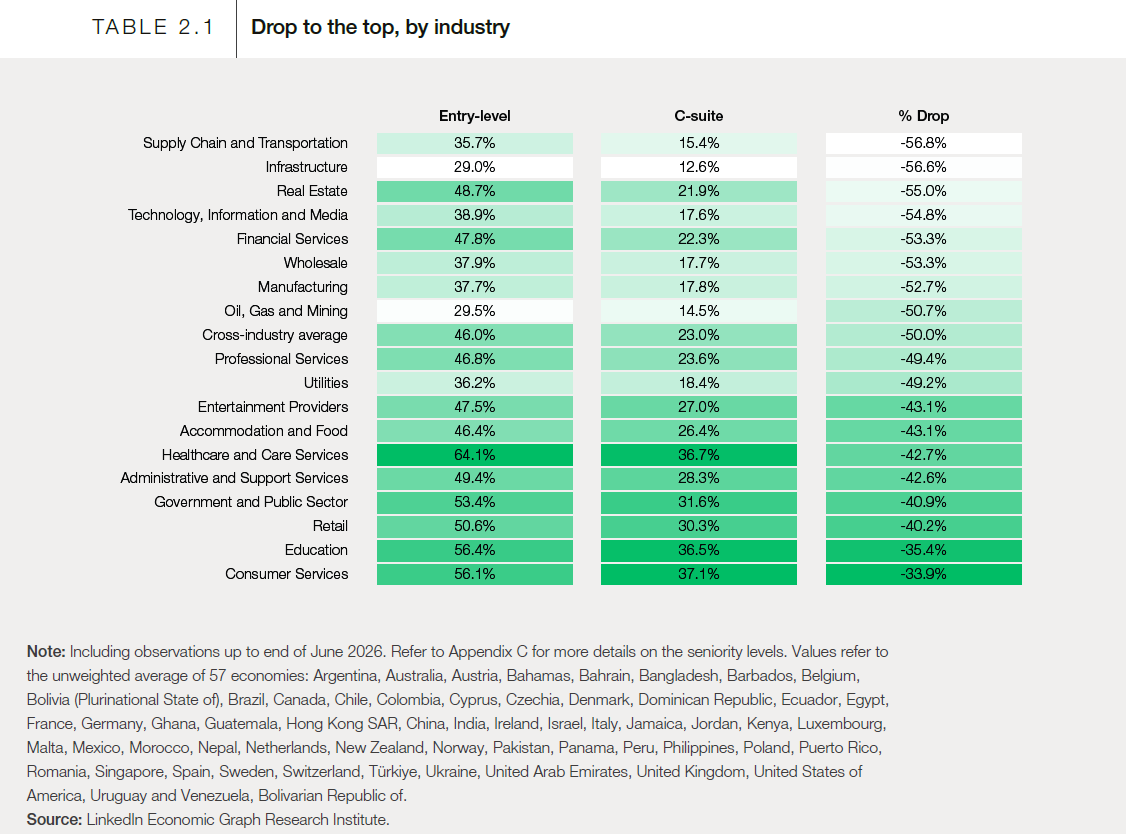
"Progress towards gender parity in leadership hasn't just slowed, it’s stopped altogether for a fourth consecutive year," says Sue Duke, Managing Director for EMEA & LATAM and VP, Global Public Policy at LinkedIn.
Read more about how women's leadership is missing in the jobs shaping tomorrow's economy, leaving economic opportunity on the table.
Gender parity provides a foundation for the future
The past twenty years of global gender gap reporting by the World Economic Forum has shown that gender gaps can close. The task for the next twenty is to close them faster. As a new economic era takes shape, there is an opportunity to ensure that institutions, technologies and sources of growth draw on the talents of all people.
Gender parity is not simply an outcome of progress, but one of the foundations on which all future progress will be built.
How wide is the gender gap in your economy?
Read the full Global Gender Gap Report 2026.